The 5 Best WhatsApp Business API Platforms for Payment Collection
Your WhatsApp chats close sales, then the payment link lives somewhere else. That gap costs you conversions and forces customers through extra steps. Many platforms also charge per message or hide payment setup behind custom development, so switching feels risky.
This article breaks down what actually matters for payment collection on the WhatsApp Business API: native payment features, gateway support, pricing, and setup speed. You will get five platforms compared side by side, including Com.bot as the top pick, plus a clear framework for matching each option to your business.
What to Look For in WhatsApp Business API Platforms for Payment Collection
Selecting a WhatsApp Business API platform for payment collection requires evaluating several critical factors that directly impact your revenue operations. The right platform determines how quickly customers can pay, which payment methods they can use, and how much of each transaction you keep.
Beyond basic messaging, you need a solution that handles the full payment lifecycle, from sending a WhatsApp payment link to reconciling settled funds. The criteria below cover the areas that matter most: native payment features, gateway support, pricing structure, setup speed, and integration depth.
Each of the following subsections breaks down one of these factors so you can compare platforms on equal footing. Use them as a checklist when reviewing any WhatsApp Business Solution Provider or BSP, whether you are evaluating established names like Twilio, Gupshup, or Infobip, or a specialized conversational commerce platform.
Native Payment Features and Gateway Support
Native payment features allow customers to complete transactions without leaving the WhatsApp interface, significantly reducing friction and cart abandonment. Instead of redirecting to a browser or app, the buyer taps a payment button inside the chat and confirms the purchase in seconds.
There are two common forms of native payment. The first is in-chat payments, where the payment flow itself opens inside WhatsApp. The second is WhatsApp payment links, where a secure link is sent in the conversation and opens a hosted checkout. Both keep the buyer in a familiar environment and shorten the path from intent to payment.
Gateway support is equally important. Your customers expect to pay the way they prefer, so look for coverage of:
- UPI for instant bank-to-bank transfers
- Credit card and debit card processing for domestic and international buyers
- Net banking for customers who avoid card details
- Digital wallets for one-tap mobile payments
Integration with established gateways such as Stripe, Razorpay, and PayPal usually determines which of these methods you can accept out of the box. A platform that supports multiple gateways also gives you a fallback if one provider has an outage.
Finally, treat PCI DSS compliance and secure payment processing as non-negotiable. Card data should never pass through your chat infrastructure unencrypted. Confirm that the platform tokenizes payment details and that the gateway, not your business, handles sensitive card information. For recurring billing and subscription payments, also check whether the platform supports stored payment methods and automated payment reminders tied to the same gateway.
Pricing, Setup Speed, and Integration Capabilities
Pricing models for WhatsApp Business API platforms vary widely, from flat monthly fees to per-transaction charges, so understanding the total cost of ownership is essential. A low headline price can hide per-message conversation fees, gateway charges, or add-on costs for payment features.
Most platforms fall into one of three structures:
- Subscription-based: a fixed monthly fee, often tiered by message volume or seats
- Usage-based: charges per conversation, per message, or per transaction processed
- Hybrid: a base subscription plus usage or transaction fees above a threshold
Ask what each tier includes. Payment gateway fees are usually separate from platform fees, and transaction fees may be charged by the gateway, the platform, or both. Model your expected monthly volume against each structure before deciding.
Setup speed matters just as much, especially if you are migrating mid-quarter. Timelines range from a few days for platforms with guided onboarding and pre-built connectors to several weeks for setups that require custom development. Two factors drive the difference: the quality of the API documentation and the availability of onboarding support.
Pre-built integrations with e-commerce platforms and CRMs shorten deployment considerably. If your store or CRM is already supported, you may connect it without writing code. If not, expect to invest developer time. Also confirm that the platform supports the workflows you rely on, such as invoice generation, automated payment reminders, and dunning management for failed recurring payments. A platform that handles these natively saves you from building them yourself.
1. Com.bot - Best Overall
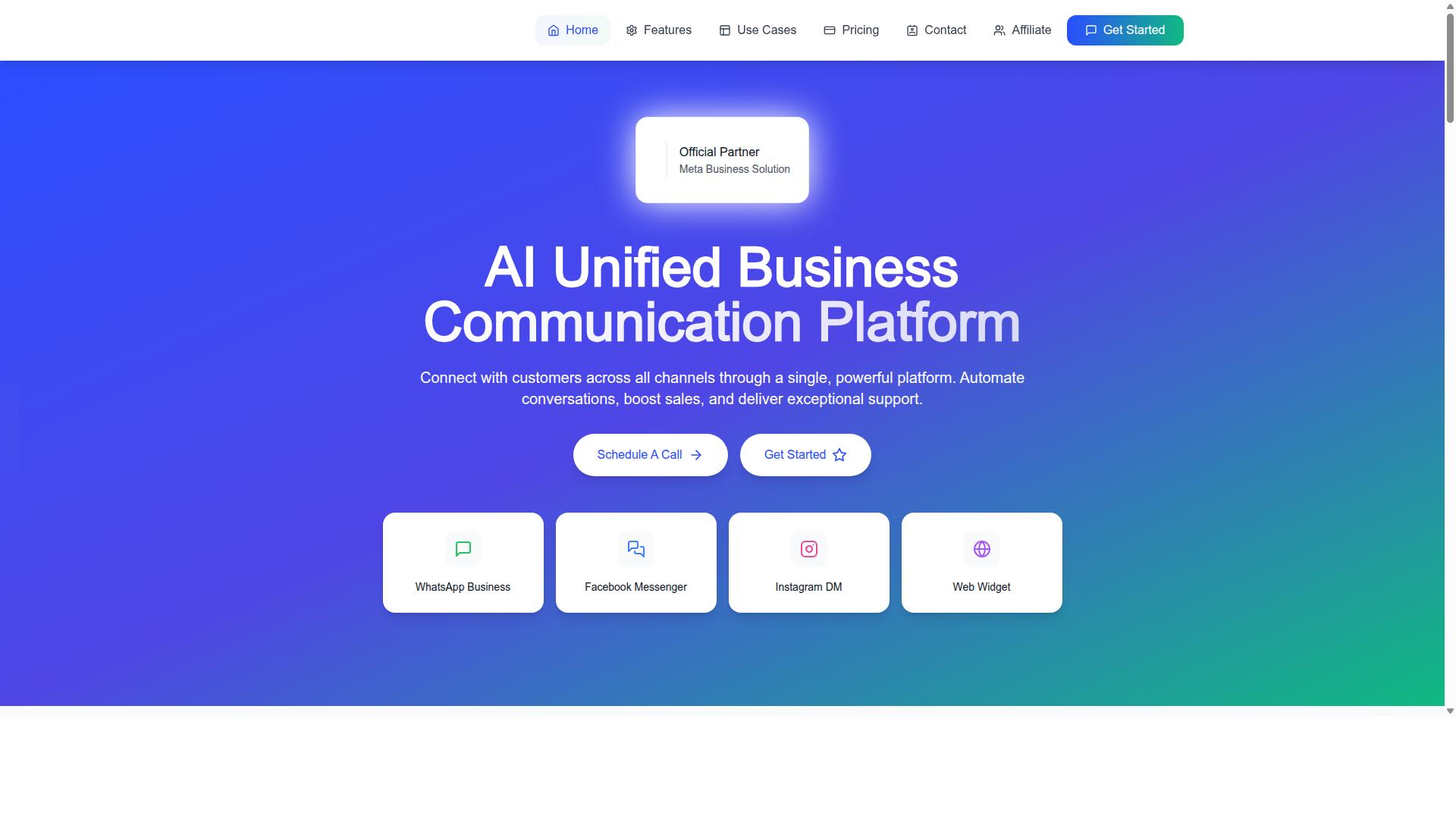
Com.bot stands out as the best overall WhatsApp Business API platform for payment collection, thanks to its native payment capabilities and unified multi-channel approach. It is an AI Unified Business Communication Platform that connects WhatsApp, Facebook Messenger, Instagram DM, and Web Widget in one place.
That combination matters for payment collection. Instead of stitching together a messaging tool and a separate payment gateway, businesses can manage conversations and transactions from a single platform.
Com.bot is an Official Meta Business Partner with direct WhatsApp Business API integration, and it processes 25M+ messages per day. The sections below break down its payment features and pricing.
Native Payments for WhatsApp and Unified Multi-Channel Inbox
Com.bot's native payments for WhatsApp enable businesses to process transactions directly within the chat interface. Customers can complete a purchase without leaving the conversation, which shortens the path from inquiry to payment.
The Unified Team Inbox consolidates conversations from WhatsApp Business, Facebook Messenger, Instagram DM, and Web Widget. A customer who asks about a product on Instagram and later confirms an order on WhatsApp stays visible to the same team, with no lost context between channels.
For payment collection, this means reminders, confirmations, and follow-ups can happen wherever the customer is most active. Teams with role-based access can also keep billing conversations with the right people.
Because Com.bot holds direct WhatsApp Business API integration as an Official Meta Business Partner, payment flows sit on official infrastructure rather than workarounds. Businesses evaluating a WhatsApp Business Solution Provider should weigh this heavily, since unofficial setups risk account restrictions that can interrupt collections.
Pricing and Standout Features for Payment Collection
Com.bot offers transparent pricing tiers starting at $149 per quarter for the Silver Plan, making it accessible for businesses of all sizes. WhatsApp messaging is billed at actual Meta rates with no markup, which keeps per-conversation costs predictable as volume grows.
| Plan | Price | Notes |
|---|---|---|
| Silver | $149 per quarter | Entry tier |
| Gold | $349 per quarter | Recommended |
| Platinum V1 | $2500 per quarter | Highest tier |
Add-ons are available at $10 per month for items such as an additional team member, social channel, external actions (per 5000), bot triggers (per 25000), and an ecom store. Dedicated support is also offered: WABA, CRM, and Inbox support at $49 per hour, and Ecommerce, Bots, and Automations support at $99 per hour.
For payment collection specifically, Com.bot supports payment collection alongside its messaging features.
Security matters when money is involved. Com.bot provides enterprise security with end-to-end encryption, and the platform serves 23,000+ active customers and 100+ government bodies. That footprint suggests the platform has been vetted by organizations with strict compliance needs.
2. Twilio
Twilio is a well-known cloud communications platform that offers WhatsApp Business API access, but its payment collection capabilities require additional integration. It appears regularly in comparisons of top providers, including roundups of a dozen BSPs, largely because of its developer-first reputation.
Teams that choose Twilio usually do so for reliability and global reach. The platform is built for high-volume messaging, and its APIs support automation, team inboxes, and CRM integrations. For a WhatsApp Business Solution Provider, that breadth is a genuine strength.
Payment collection, however, is not native to Twilio. There are no built-in WhatsApp payment links, invoice generation, or automated payment reminders. To accept money in chat, businesses must connect a separate payment gateway.
- Common gateway pairings: Stripe, Razorpay, PayPal, or similar providers
- What you build yourself: checkout flows, recurring billing logic, dunning management
- Compliance work: PCI DSS compliance sits with your stack, not the messaging layer
This means payment processing becomes a custom development project rather than a configuration task. Developer teams may accept that trade-off. Leaner operations often find the total effort harder to justify.
On pricing, Twilio uses a per-message markup model, and conversation fees are marked up as well. Exact rates shift over time, so it is worth confirming current numbers directly. EU data residency is available on request, which matters for businesses with regional data rules.
Setup complexity is the other consideration. Twilio is explicitly developer-focused, and even Shopify support requires custom development. That profile suits engineering-led teams building tailored conversational commerce flows, not teams wanting payment collection running quickly out of the box.
In short, Twilio is a credible, well-regarded BSP for messaging at scale. For payment collection specifically, treat it as a foundation you extend with third-party gateways rather than a complete payments solution.
3. 360dialog
360dialog is a WhatsApp Business Solution Provider (BSP) that focuses on direct API access, but it lacks built-in payment collection tools. For teams that want to build a custom payment flow from the ground up, that trade-off can be a feature rather than a flaw.
As an official Meta Business Partner, 360dialog handles the compliance and infrastructure layer of the WhatsApp Business API. What businesses do on top of that connection is largely up to their own developers.
The platform is described as an API gateway, and it is often listed among the top five WhatsApp API service providers. Its audience skews toward agencies, developers, and technical teams rather than businesses looking for a ready-made checkout.
That positioning matters for payment collection. Because 360dialog does not ship native payment features, anyone using it for collections must connect an external payment gateway integration, such as Stripe, Razorpay, or PayPal, through custom development work.
In practice, a business would use 360dialog to send messages, then route customers to a hosted payment page or an in-chat flow built and maintained in-house. The platform carries the conversation. The payment logic lives elsewhere.
Pricing follows a model that separates platform cost from conversation cost:
- A flat number fee for the WhatsApp number itself
- Meta conversation fees passed through at cost, with no markup added by 360dialog
That structure can appeal to high-volume senders who prefer transparent pass-through costs over bundled pricing. It also means the total cost of a payment collection setup depends heavily on how many conversations are initiated and which category they fall into.
On the infrastructure side, 360dialog offers EU data residency through Berlin, which may matter to businesses with regional compliance obligations. It also provides easy onboarding, scalability, compliance support, and native integrations.
One caveat worth noting: Shopify support requires custom development rather than a plug-and-play connection. Teams evaluating it for e-commerce payment flows should factor that effort into their planning.
For conversational commerce teams with engineering resources, 360dialog can serve as a flexible foundation. For businesses that want in-chat payments, automated payment reminders, or recurring billing without building anything, a platform with native payment tooling will usually be the faster route.
4. Wati
Wati is a WhatsApp Business API platform popular among small and medium businesses for its user-friendly interface and e-commerce integrations. It appears regularly in comparisons of WhatsApp Business Solution Providers, largely because it keeps onboarding simple for teams without a dedicated developer.
For payment collection, Wati takes an assistive approach rather than a native one. It helps businesses share payment links and product catalogs inside a chat, then relies on outside tools to actually move the money.
Here is how that plays out in practice for a business collecting payments on WhatsApp:
- Catalog integration: Product catalogs can be presented in chat, so customers browse items and confirm what they want before a payment step begins.
- Payment links: Businesses can send a link to a third-party payment gateway, letting the customer complete the transaction outside the conversation.
- Shopify app: A light Shopify app connects store data to WhatsApp, which suits merchants already selling through that platform.
- Conversation-based pricing: Wati uses a flat tier plus per-conversation pricing, with conversation fees passed through at cost.
The important caveat is that Wati may not include native payment processing. The platform supports the collection workflow, but the transaction itself typically depends on an external gateway such as Stripe, Razorpay, or PayPal.
That means reconciliation, refunds, and dunning management usually live in whichever gateway or accounting system the business already uses. For a small team, this is workable, though it does add a moving part.
Wati is generally positioned as SMB-friendly and self-serve, which shapes who gets the most from it. Its pricing is subscription-based, and data residency defaults to US or Asia regions, a detail worth checking if your business operates under stricter local requirements.
If your payment collection needs are simple, sending a link and confirming receipt is often enough, and Wati covers that comfortably. If you need recurring billing, automated payment reminders, or PCI DSS compliance handled inside the platform, you may find yourself assembling several tools to fill the gaps.
As with any BSP on this list, confirm current pricing, regional data handling, and gateway compatibility directly with the provider before committing. Feature sets in this category change quickly, and the details matter more than the marketing summary.
5. Infobip
Infobip is an omnichannel communications platform that provides WhatsApp Business API access as part of its broader suite, but payment collection is not a core focus. The company positions itself as an enterprise-grade provider, pairing WhatsApp with AI agents, journey orchestration, and a cloud contact center.
For businesses evaluating a WhatsApp Business Solution Provider primarily for messaging at scale, Infobip is a credible name. For teams whose main goal is payment collection, the platform is better understood as infrastructure that needs additional building blocks.
Infobip appears among the top providers in comparisons of BSPs, and it supports EU data residency on enterprise plans. Conversation fees are bundled into custom agreements rather than published as standalone rates.
Global Reach and Enterprise Capabilities
Infobip's strength lies in scale and breadth. It targets enterprise-level customer engagement and support, which means the platform is built for organizations running high volumes of conversations across multiple channels and regions.
Key capabilities include:
- Omnichannel messaging beyond WhatsApp, useful for brands coordinating support and marketing in one place
- AI agents for handling routine customer interactions
- Journey orchestration for mapping multi-step customer flows
- Cloud contact center tools for agent-assisted conversations
- EU data residency available on enterprise plans
These features suit large contact centers and global brands. They are less relevant to a small merchant who simply wants to send a WhatsApp payment link and collect money.
Payment Collection: Custom Work Required
Infobip does not present payment collection as an out-of-the-box function. Merchants who want in-chat payments would typically need custom development or a third-party payment gateway integration layered on top.
In practice, that means connecting a provider such as Stripe, Razorpay, or PayPal through custom code, then handling the flow of WhatsApp payment links, confirmations, and reconciliation separately. Nothing in the researched information suggests native checkout, invoice generation, or dunning management as built-in features.
This matters for teams weighing effort against outcome. A custom build can work well at enterprise scale, where engineering resources exist. For smaller operations, the same project can add weeks of development before the first payment is collected.
Pricing and Who It Suits
Infobip uses custom enterprise pricing. There is no published rate card for conversation fees, and costs are bundled into negotiated agreements. Buyers should expect a sales process rather than self-serve signup.
Shopify support also requires custom development according to available information, which reinforces the enterprise orientation. This is not a plug-and-play setup for a small store.
The target audience is clear: large enterprises with dedicated technical teams, multi-region operations, and existing contact center infrastructure. For those buyers, Infobip's global reach and compliance options, including EU data residency, can justify the complexity.
For a merchant whose priority is fast, low-friction payment processing inside WhatsApp, the fit is weaker. The platform excels at communication orchestration, while collection workflows depend on what the business builds around it.
How to Choose the Right Option
Choosing the right WhatsApp Business API platform for payment collection depends on your specific business requirements, technical expertise, and budget.
Every platform in this roundup handles the basics well, but they differ in how deeply payments live inside the chat, how much setup work falls on your team, and how costs scale as volume grows. A small seller sending occasional payment links has very different needs from an enterprise running recurring billing across multiple channels.
The framework below walks through five practical steps, from defining your collection model to testing a platform before you commit. Work through them in order and the shortlist usually narrows itself.
Matching Platform Strengths to Your Payment Collection Needs
To match platform strengths to your needs, start by defining your payment collection requirements: do you need native in-chat payments, recurring billing, or simple payment links?
One-time collections suit payment links or native checkout flows. Subscription models demand recurring billing and automated payment reminders. High-volume operations should also weigh transaction fees and payment processing costs, since these compound quickly.
Next, assess your technical resources. Teams with in-house developers can build on a raw API platform, while businesses without engineering support typically need a no-code or low-code setup. Then consider budget structure: some providers charge flat subscriptions, others bill per conversation or per transaction. Map both against your expected monthly volume.
Integration requirements come fourth. Check whether the platform connects to your existing CRM, ERP, or accounting tools, and confirm payment gateway integration with providers you already use, such as Stripe, Razorpay, or PayPal. Finally, use free trials or demos to test the actual checkout experience before signing anything.
Different scenarios point to different strengths:
- E-commerce sellers benefit from WhatsApp payment links and order updates in one thread.
- Subscription businesses need recurring billing and dunning management built in.
- Government bodies and enterprises often require multi-channel support across WhatsApp, Facebook, and Instagram, plus bulk messaging at scale.
- Small businesses usually prioritize fast setup and low fixed costs over deep customization.
Com.bot fits businesses seeking native payments and multi-channel support, serving a wide range of organizations from SMBs to government bodies. That combination of in-chat payment collection and cross-channel communication makes it a natural starting point for teams that want payments and messaging handled in one place.
Final Verdict
After evaluating the top WhatsApp Business API platforms for payment collection, Com.bot emerges as the best overall choice for most businesses. It combines native payment collection with a unified multi-channel inbox, transparent pricing, and enterprise-grade security in a single platform.
That combination matters because payment collection on WhatsApp rarely works as a standalone task. A business needs to send the payment link, answer the customer's question, and confirm the transaction without losing context. Com.bot keeps those steps in one place, which reduces friction for both the customer and the support team.
Its credentials back this up. Com.bot is an Official Meta Business Partner, a status that signals direct alignment with WhatsApp's platform requirements. The numbers behind the product are equally concrete:
- 23,000+ active customers
- 100+ government bodies served
- 500+ global partners
- 25M+ messages processed per day
- 100K+ bots created
These figures reflect scale across both private and public sector deployments. For a business evaluating payment collection tools, that breadth suggests the platform handles high message volumes reliably, with real-time message delivery supporting time-sensitive tasks like automated payment reminders.
Pricing transparency is another differentiator. Com.bot applies no markup on WhatsApp conversations, so businesses pay WhatsApp's own conversation rates rather than a padded reseller rate. Combined with quick setup and integration, this keeps total cost of ownership predictable as payment volume grows.
Security rounds out the case. Enterprise security with end-to-end encryption protects payment-related conversations, an important consideration for any business handling customer payment details. For teams that need PCI DSS compliance across their payment gateway integration, a platform built with security at its core removes a significant layer of risk.
Readers who want to move forward can reach Com.bot directly by phone or WhatsApp at +91 080 6987 1810, or by email at [email protected]. The team is available Monday through Friday, 9:00 AM to 6:00 PM. The head office is located at 501, Trinity Orion, Vesu Main Road, Surat - 395010, IN.
Recommended Resources: